
What an SEO competitor tracker does
An SEO competitor tracker records where you and each competitor rank in Google for the same searches, on the same day, in the same country, and keeps the record. Over a few weeks it shows which rival is gaining on which searches, and which of your pages are slipping.
The keyword research tools sold for this cost a lot and answer a different question, about the whole web. We answer a narrower one, every week: on the searches your buyers make, are you ahead of the stores you compete with, and what changed since last week?
In short: every week we read your rankings and each competitor’s for your keywords, show who leads where and bring up the moves that matter in your weekly email.
What you see
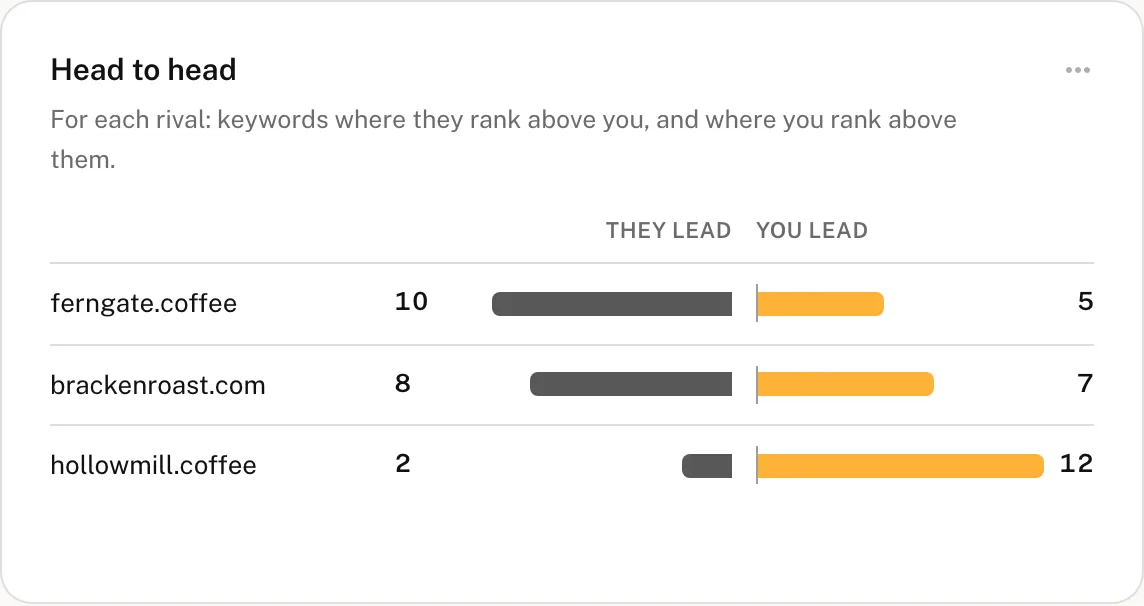
Head to head. For each competitor, the searches where they rank above you and the ones where you rank above them. It’s the quickest read of where you stand.
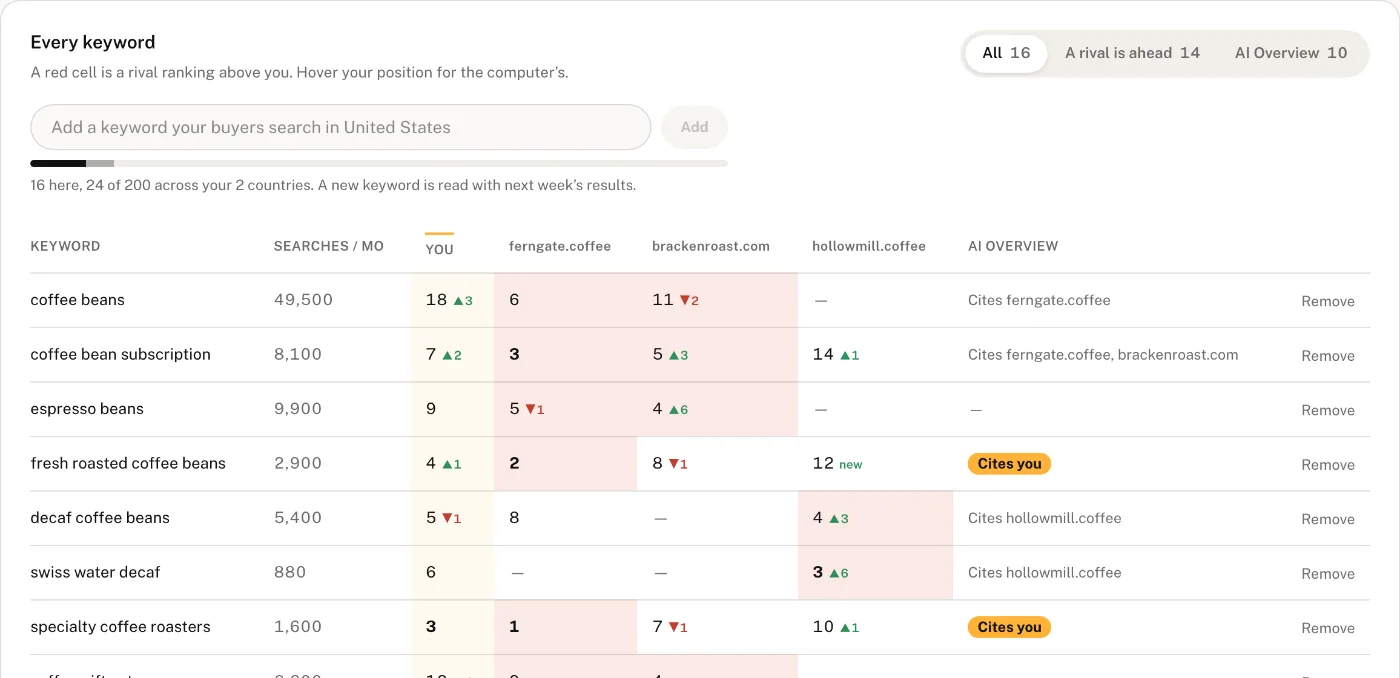
Every keyword. Each keyword with its monthly searches, your position, each competitor’s and whom Google’s AI Overview cites for it. A red cell is a competitor ranking above you. The arrows show the move since last week.
The keyword gap. The searches where a competitor ranks and you don’t, or ranks well above you, ordered by how much they’re searched. When the data behind a row is more than 30 days old, we read that search on Google again before showing it.
Backlinks (Growth and Scale). Each competitor’s backlink profile beside yours.
The changes we bring up
- A competitor passed you on a search that matters, and by how much.
- You passed a competitor, so you know what worked.
- A competitor started ranking for a search they didn’t rank for before, often with a page they just published. We read their new pages every week too, so you see both.
- An AI Overview cites a competitor for one of your searches and not you.
Three findings at most reach your weekly email, each with its reason and what to do first. Everything else is in the dashboard.
See your competitors this week
Type your address. We find the sites that turn up next to yours in Google, in your country and language, and read them every week.
3 days free, then from $49 a month. Cancel any time.
Rankings in context
Rankings move for reasons, and the reasons usually show up somewhere else first. A rival climbs on “coffee bean subscription” two weeks after publishing a subscription guide and cutting its price. Another drops after its new site goes live with half its pages gone.
Because we read the same competitors’ pages, prices and promotions every week, those reasons sit on the same timeline as the rankings. We report what changed and what happened at the same time. We don’t claim one caused the other.
How it compares
| An SEO suite (Semrush, Ahrefs) | Over the Fence | |
|---|---|---|
| Built for | Keyword research, audits and links across the whole web | Watching the competitors you name |
| Competitors’ Google rankings | Yes | Yes, weekly, for your keywords |
| Competitors’ prices, stock and promotions, product by product | No | Yes |
| AI Overview citations, you against each rival | Yes, on AI plans or add-ons | Yes, on every plan |
| A weekly email of what changed | Partly, in some toolkits | Yes, three findings at most |
| Entry price, billed monthly | Semrush from $139 a month | $49 a month |
Semrush’s price is from its pricing page, read October 2, 2026. If you do SEO for a living, you probably want a suite. If you run a store and want to know where you stand against the stores you compete with, start here.
What it costs
Every plan starts with 3 days free. Starter is $49 a month for 100 keywords and 3 competitors, Growth $119 for 200 keywords, 6 competitors and backlinks, and Scale $249 for 300 keywords and 12 competitors.