
What competitor price monitoring is
Competitor price monitoring means reading your rivals’ product pages on a schedule and keeping every price you find, with the date you found it. Over a few weeks that history shows each cut, rise, sale and sell-out, and how deep and how long each one ran.
Most small stores do it by hand. Someone opens the three or four sites that matter, checks a few products and pastes the numbers into a spreadsheet. It works until it’s a busy week, and it never tells you what you didn’t look at. Software does the same reading every day without forgetting, and it keeps the record.
In short: we read your competitors’ prices for you, the products that matter every day and the rest every week. You get the moves that matter in one email, each with the page it came from.
What we read, and how often
| What we read | How often | Starter | Growth | Scale |
|---|---|---|---|---|
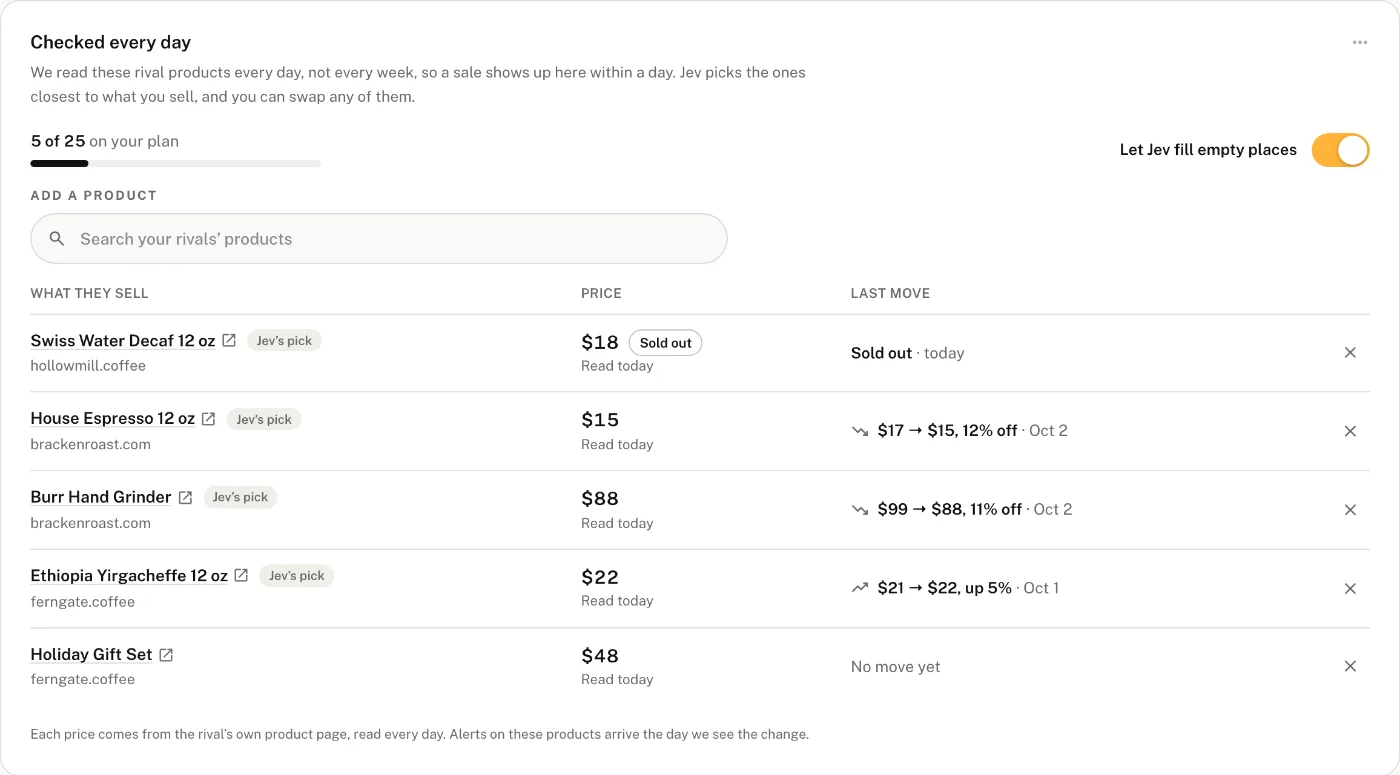
| Your daily list of rival products: price and stock | Every day | 10 products | 25 products | 50 products |
| Every page on each rival’s website, product pages included | Every week | 500 pages | 2,000 pages | 8,000 pages |
| Banners and offers on each rival’s homepage | Every day | Yes | Yes | Yes |
| Competitors watched for each site | 3 | 6 | 12 |
A price comes from the product page itself. Most store platforms publish each product’s price, currency and stock in the page’s structured data, which is what Google reads too. Where a page doesn’t, we read the price off the page the way a shopper would, and we mark anything we aren’t sure of rather than guess.
How it works
- Type your store’s address. We read your homepage and work out what you sell and in which country.
- Keep the competitors we suggest, or name your own. We suggest the stores that turn up next to yours in Google, in your country and language.
- Check the daily list. We pick the rival products a shopper choosing among yours would weigh instead. Swap any of them for your own picks.
- We read. The daily list every day, the rest of each rival’s website every week, and each rival’s homepage banners every day.
- You hear about what changed. A big move on a listed product reaches you the day we see it. Once a week, an email brings three findings at most, each with its reason and what to do first. The dashboard keeps everything else.
Promotions, not just prices
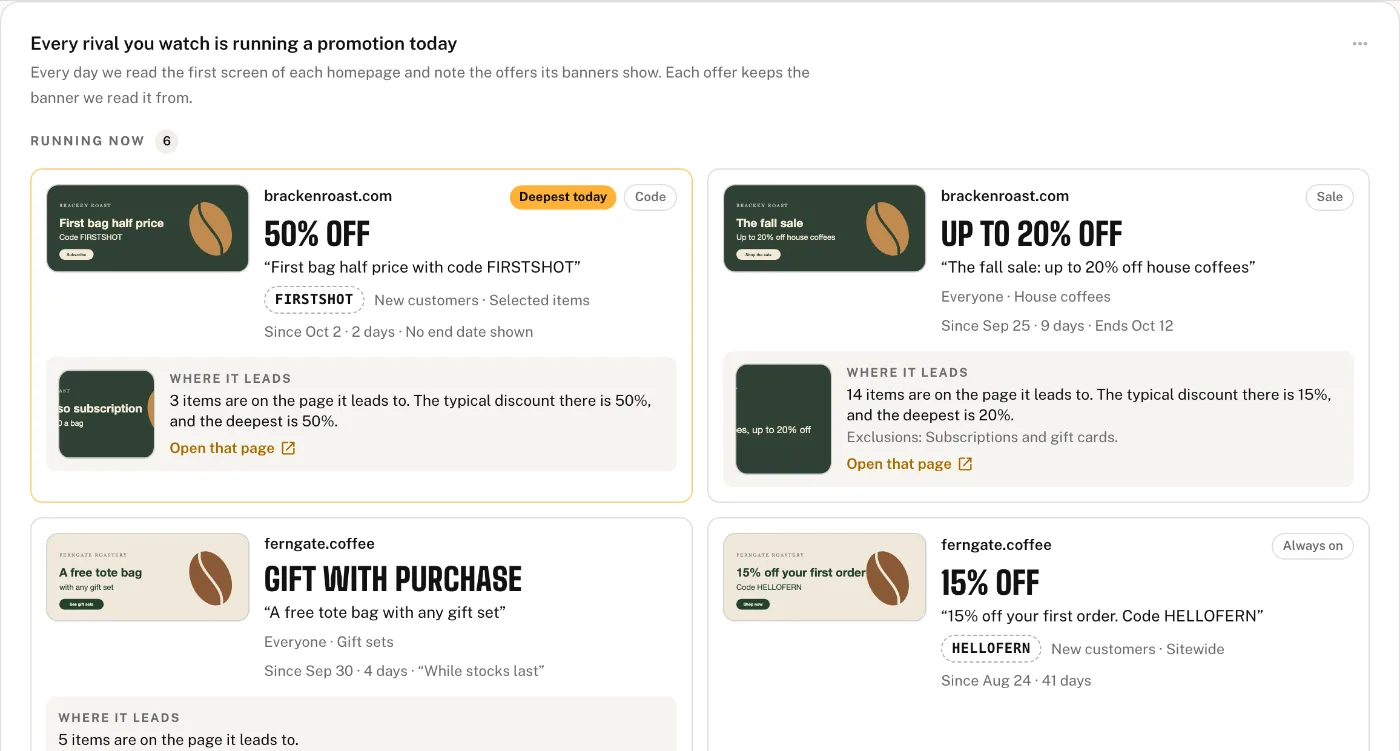
A price list only tells half of it. Many cuts never touch the price on the product page: a code in a banner, a free gift over $50, first order 15% off. So every day we read the top of each rival’s homepage the way a browser shows it, and we note each offer its banners and top bar carry.
Each promotion keeps the banner we read it from, its code if there is one, who it’s for and how long it has run. When a banner leads to a sale page, we follow it one level deeper and count what’s on sale there and how deep the discounts go.
Stock
A rival selling out of a product you also sell is a chance to win those shoppers. A rival restocking is the end of it. We record stock on every product page we read, and for the products on your daily list, selling out and coming back both alert the day we see them.
Across a rival’s whole catalog, stock moves daily and most of it is noise, so the weekly email only brings up the stock moves worth your time.
See your competitors this week
Type your address. We find the sites that turn up next to yours in Google, in your country and language, and read them every week.
3 days free, then from $49 a month. Cancel any time.
What we don’t do
We’d rather you knew before you start a trial.
- We don’t reprice your products. We report and you decide. Repricing tools change your prices by rules and need access to your store. That’s a different job.
- We don’t estimate anyone’s sales. We can see what a rival charges and whether it’s in stock. We can’t see what they sell, and we won’t guess.
- We aren’t minute by minute. The daily list is read once a day and everything else once a week. That catches a weekend sale, but not a flash sale that lasts an hour.
- We only read public pages. No logins, no member prices, nothing behind a block. If a rival blocks us, the dashboard says so and keeps the last reading.
Price monitoring compared with the other ways to do it
| A spreadsheet by hand | A repricing tool | Over the Fence | |
|---|---|---|---|
| Who does the reading | You or your team | The software | We do |
| Changes your own prices | No | Yes, by rules | No |
| Promotions and banners | If you spot them | Some do | Every day, with the banner |
| Your rivals’ Google rankings and AI Overview citations | No | No | Yes |
| History you can go back to | As good as the sheet | Yes | Yes, every reading kept |
| Typical cost | Your hours | Repricing usually from $99 a month | From $49 a month |
Prices also sit beside everything else we read on the same rivals: their new pages, their Google rankings and how often Google’s AI Overviews cite them. A price cut that arrives with a new landing page and a climb in Google tells a different story from a quiet clearance.
What it costs
Every plan starts with 3 days free, and you can cancel any time from your dashboard.
| Plan | Price | Competitors per site | Daily products | Pages read per website, weekly |
|---|---|---|---|---|
| Starter | $49 a month | 3 | 10 | 500 |
| Growth | $119 a month | 6 | 25 | 2,000 |
| Scale | $249 a month | 12 | 50 | 8,000 |
Each plan includes one site. More sites cost $25, $49 or $99 a month each, and get the same competitors and pages as your plan.