
What an AI Overview tracker does
An AI Overview is the summary Google writes at the top of some search results, with links to the pages it drew from. An AI Overview tracker records, for each search you care about, whether Google showed one, which websites it cited and how that changed since last week.
For a store, the useful question isn’t “am I in AI Overviews?” but “am I in them more or less than my competitors, and for which searches?” That’s what we track.
In short: for every keyword you track, we record whether Google shows an AI Overview and whom it cites. Across a wider sample of searches in your market, we count how often AI Overviews cite you and each competitor, every week.
Two views of AI Overviews
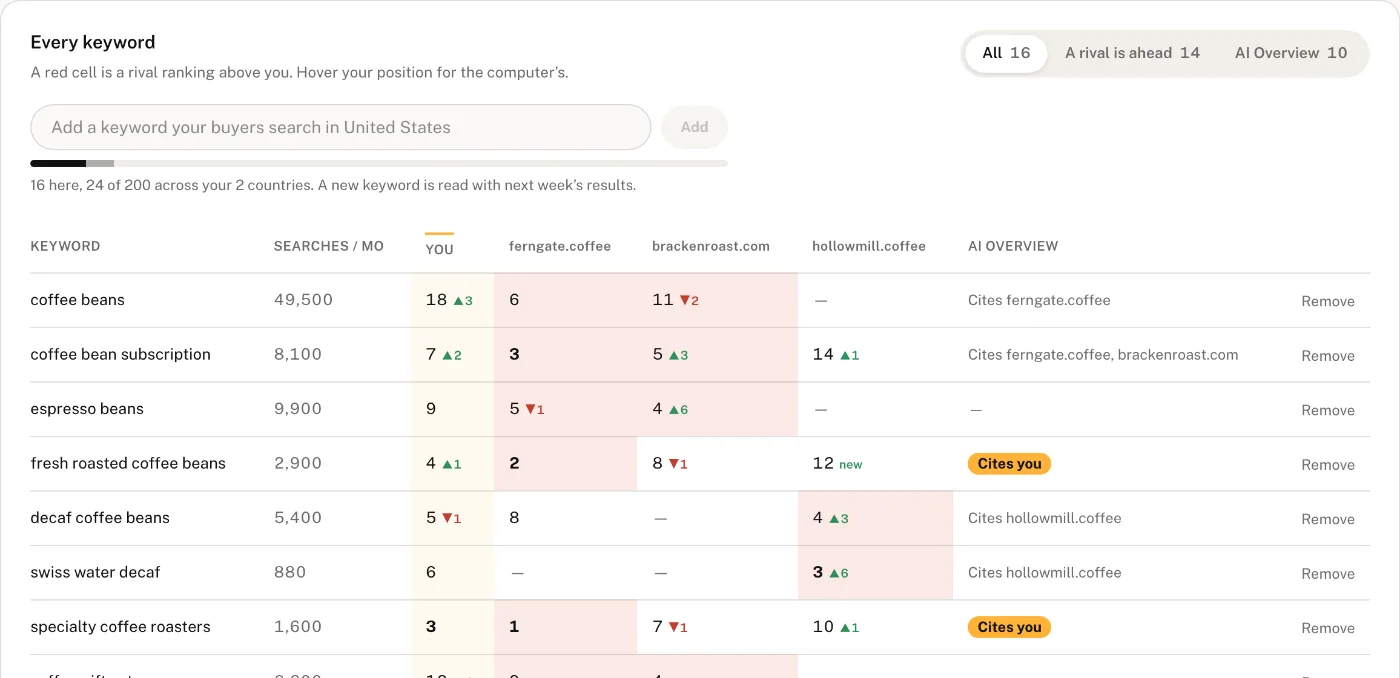
Keyword by keyword. Every keyword in your rank tracking (100, 200 or 300 per site depending on your plan) gets an AI Overview column. It shows whether Google showed an AI Overview for that search and which websites it cited. A filter shows only the searches with an AI Overview, so you can see at a glance where Google answers before anyone ranks.
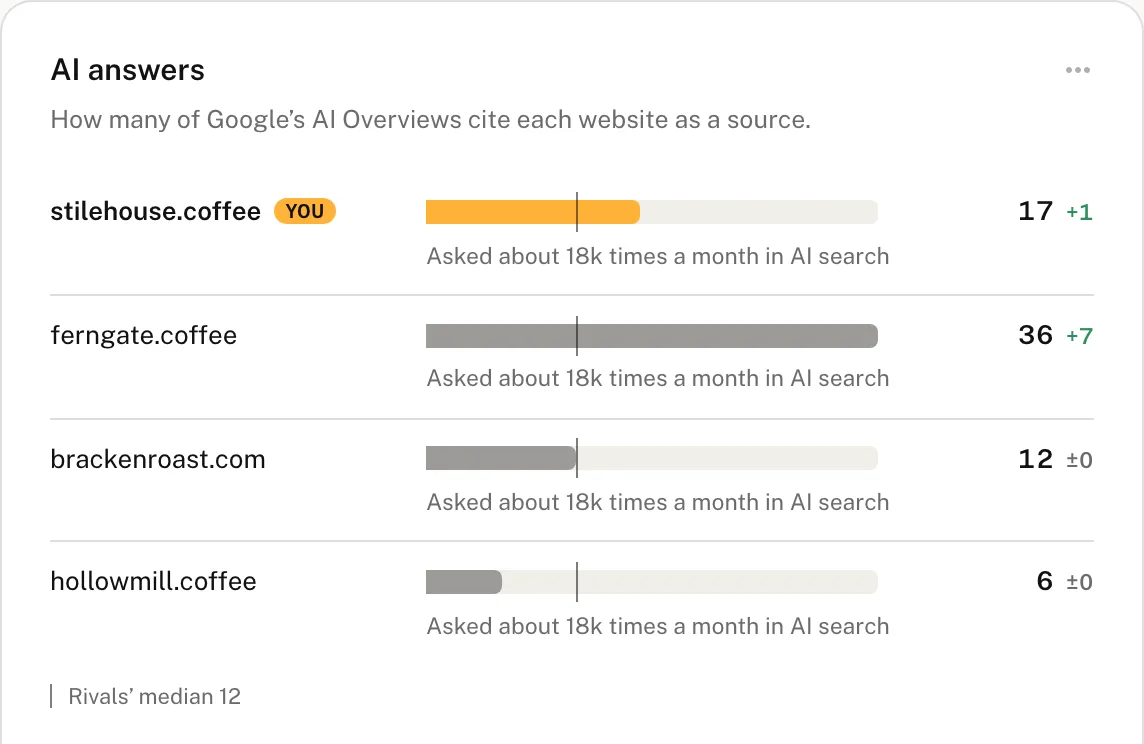
Across your market. Your own keywords are a small window. So we also count how many AI Overviews cite each website across a wide sample of searches in your country and language, from our data provider’s AI Overview data. That’s the number that shows whether your share is growing, with each competitor’s beside it and the questions behind each count.
How to get cited in Google’s AI Overviews
There is no form to fill in. Google picks the sources it trusts for each search, and the pages it cites tend to have a few things in common:
- They rank, though less than they used to. In a study of 863,000 searches published March 2, 2026, Ahrefs found that 38% of the pages AI Overviews cite rank in the top 10 for the same search, down from 76% in its July 2025 study. Ranking helps, and a page outside the first page can still be cited.
- They answer the question in the first lines. A plain sentence that defines, compares or recommends, near the top of the page, is easy to quote.
- They state facts a machine can read. Price, size, material, stock, ratings. A table or the page’s structured data beats a paragraph of marketing.
- They let the crawler in. A page blocked in robots.txt, or rendered only by JavaScript that never loads for a crawler, can’t be quoted.
- They’re cited elsewhere. Reviews, guides and forums that mention a store make it a safer source to cite.
The tracker turns that into a list for your own store: the searches where a rival is cited and you aren’t, the page Google cites instead and what that page states that yours doesn’t.
See your competitors this week
Type your address. We find the sites that turn up next to yours in Google, in your country and language, and read them every week.
3 days free, then from $49 a month. Cancel any time.
What we tell you each week
- A rival overtook you in AI Overview citations, in one of your languages.
- You gained or lost a citation on a search that matters, with the answer and its sources.
- A big move in your share or a rival’s since last week.
Three findings at most reach your weekly email. The rest wait in the dashboard, each with the answer it came from.
What it isn’t
- Not a rank. AI Overviews don’t have positions the way search results do. We count citations in a sample of answers and say so on every screen.
- Not a promise of traffic. A citation is a link inside the answer. How many people click it varies, and we don’t invent a number for it.
- Not every AI engine. We track Google’s AI Overviews. Not ChatGPT, Perplexity, Gemini or Claude yet.
What it costs
The AI Overview tracker comes with every plan, alongside your competitors’ prices, pages and Google rankings. Starter is $49 a month for 3 competitors and 100 keywords, Growth $119 for 6 and 200, and Scale $249 for 12 and 300. Every plan starts with 3 days free.